25–26 Classics 5 – Program Notes: Dvořák “New World Symphony”
7:30 PM | Santander Preforming Arts Center
Andrew Constantine, Conductor
Classics 5
Violin Concerto in D Major, Op. 35
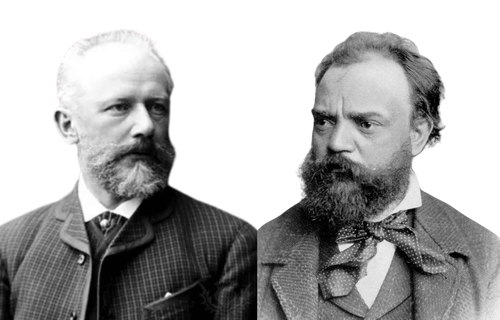
Pyotr Ilyich Tchaikovsky (1840–1893)
Written: 1878
Movements: Three
Style: Classical
Duration: 40 minutes
In the summer of 1877, Tchaikovsky undertook the disastrous marriage that lasted less than three weeks and resulted in his emotional collapse and attempted suicide. He decided that travel outside Russia would be a balm to his spirit, and he duly installed himself at Clarens on Lake Geneva in Switzerland soon after the first of the year. In Clarens, he had already begun work on a piano sonata when he heard the colorful Symphonie Espagnole by the French composer Edouard Lalo. He was so excited by the possibilities of a work for solo violin and orchestra that he set aside the sonata and immediately began a concerto of his own.
Tchaikovsky’s Violin Concerto opens quietly with a tentative introductory tune. After a few unaccompanied measures, the violin presents the lovely main theme. The second theme begins a long buildup leading into the development, launched with a sweeping presentation of the main theme. A flashing cadenza serves as a link to the recapitulation. The Andante suggests the music of a Gypsy fiddler. The finale is imbued with the propulsive spirit of a dashing Trepak.
© 2025 Andrew Constantine
Symphony No. 9 in E Minor, Op. 95 "From the New World"
Antonín Dvořák (1841–1904)
Written: 1893
Movements: Four
Style: Romantic
Duration: 45 minutes
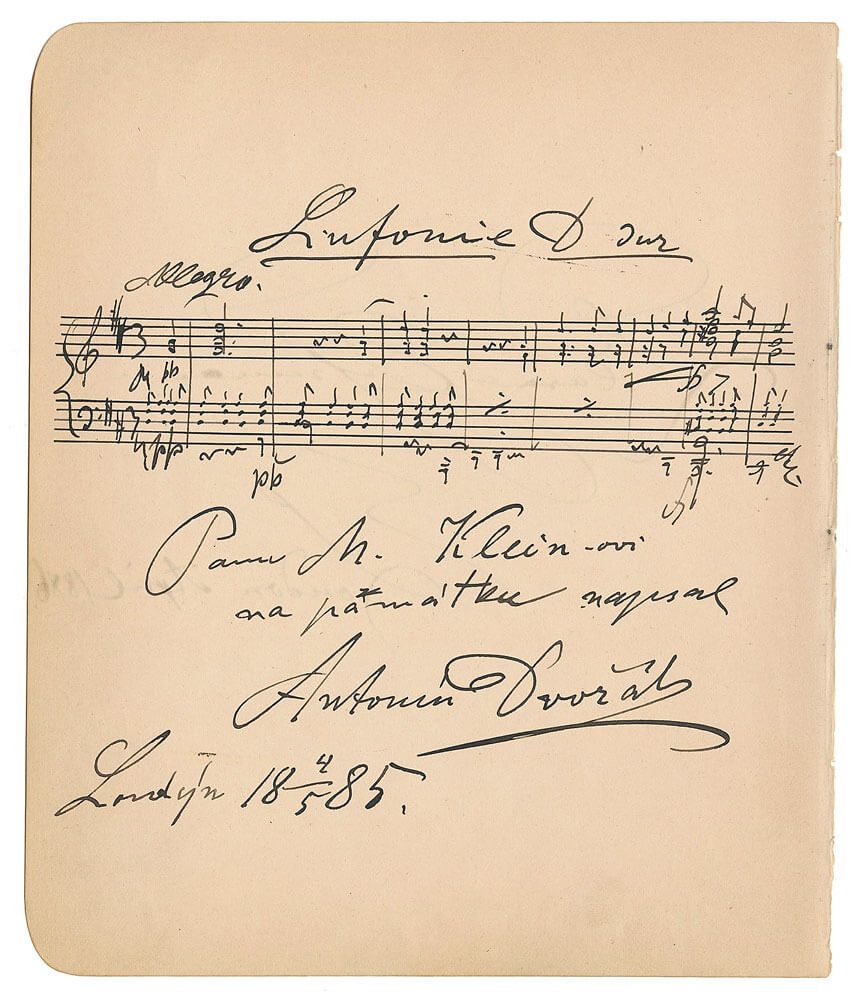
“I came to discover what young Americans had in them and to help them express it”. Perhaps in this statement we have the kernel of Dvořák’s approach to his American teaching adventure in the mid-1890s. When Mrs. Jeannette Thurber, a wealthy patron of the arts, was able to persuade the hugely celebrated composer Antonín Dvořák to become the director of her newly established National Conservatory of Music in 1892, it was seen as a tremendous coup throughout the artistic world. Notorious for enjoying his home comforts, Dvořák was certainly enticed in the main by the substantial salary he was to earn, but he was also enamored by the easy access to railway stations (he was an aficionado of all things train!) and being able to fill his apartment with canaries and other birds which flew around freely. In addition, the occasional trip, by train, to visit the Bohemian community in Spillville, Iowa was a home-from-home social experience that helped keep his spirits up!
All of this is by way of saying that, while the New World Symphony was very much a product of Dvořák’s experiences in this country—the spirit of enterprise, the energy and dynamism of the ‘new world’, the happy interactions with his students and the uncomplicated nature of Spiritual-melodies with which he so readily empathized and was truly enamored—it is still the culmination of a symphonic career, a central European career, which dated back almost thirty years. The notion of nationalism in art was viewed more as a healthy expression of heritage and belonging, rather than the parallel and more dangerous movements expressed through anarchism, revolution, imperialism and rapid commercial expansion that were taking hold of the developed world at that time.
Premiered at the recently opened Carnegie Hall on December 16th, 1893 the Symphony No.9 in E minor, From the New World, was an instant hit and probably the greatest success of Dvořák’s career. The simple, slow introduction with its folk-like undulations of pitch rather than complete melodic shapes, leads us into the faster, main part of the first movement that drives these shorter figures with great animation. To contrast with this, Dvořák introduces a second, more lyrical theme which we first hear in the flute and then repeated in the strings. The second movement, the famous Largo, is the emotional core of the symphony with its deeply expressive English horn solo. Whilst Dvořák’s family may have felt it expressed the composer’s profound homesickness, he himself professed to have taken inspiration from Longfellow’s poem “Song of Hiawatha” and Minnehaha's snow-bound funeral in particular. The third movement, a scherzo, is straight out of the Beethoven playbook in terms of its structure and momentum but, again, Hiawatha and “a feast in the woods where the Indians dance” provide the emotional content. As I noted earlier, throughout his life, Dvořák was a noted ‘train spotter’ and loved little more than spending hours on station platforms observing and recording the comings and goings of the trains and steam engines. Listening to the opening of the finale, I defy anyone to be able to leave the concert hall and not feel they have just heard a huge train slowly leaving a station, gaining momentum and then careering through the open countryside on a journey of discovery.
© 2025 Andrew Constantine

Listen