
25–26 Classics 4 – Program Notes: Mozart and Haydn
7:30 PM | Santander Preforming Arts Center
Classics 4
Symphony No. 29 in A Major, K. 201/186a
Wolfgang Amadeus Mozart (1756–1790)
Written: 1774
Movements: Three
Style: Classical
Duration: 24 minutes
Word reached Salzburg in early summer 1773 that Florian Gassmann, court music director in Vienna, had fallen seriously ill. Leopold Mozart thought that his son, Wolfgang, would make a splendid replacement for the ailing Gassmann, and the two went to Vienna in July to carry the suggestion to Empress Maria Theresa. Maria, who had bounced little Wolfgang on her knee when he visited Schönbrunn Palace a decade earlier to play for her, did not find the no-longer-boyish Mozart suitable for the position, however, and the disappointed father and son left Vienna several weeks later. Even if it failed to produce a new job, however, the trip proved to be an important milestone in the musical development of the young composer. In 1773, Vienna was home to some of the 18th century's most notable musicians. Hasse, Gluck, Gassmann, Wagenseil, Salieri, Haydn, Dittersdorf, Vanhal and other prominent composers made Vienna the greatest city of music in the world, and Mozart reveled in the expanded expressive possibilities presented by the works of this sterling aggregation during his stay there. He carried with him the excitement of this new music when he returned to Salzburg in late September, and incorporated its innovations into several of his works of the following months, including the Symphony No. 29 in A Major.
The Symphony's opening movement begins with a descending octave leap followed by a few repeated notes; the graceful second theme arrives after a moment of silence. Rather than an elaboration of previous themes, the compact development section consists of a vigorous running-about on the notes of the scale and a delicate melody whose built-in transposition carries it directly into the recapitulation and the recall of the earlier themes. The second movement, in sonata form, is elegant and refined, redolent of the sweet Rococo spirit that Mozart had learned in London from J.C. Bach a decade before. The Minuet exhibits sharp dotted rhythms and sudden dynamic contrasts that have an almost Beethovenian vigor. The finale, another sonata-form movement, mixes elements of bounding hunt music, humor (with scales flying off into silence), and masterful technique of symphonic development.
© 2013 Dr. Richard E. Rodda
Horn Concerto No. 3 in E-flat Major, K. 447
Wolfgang Amadeus Mozart (1756–1790)
Written: 1784–1787
Movements: Three
Style: Classical
Duration: 16 minutes
A friend and inspiration to many, including Haydn and Mozart, Joseph Leutgeb was one of the leading horn players of the eighteenth century. Born in 1732 and therefore over 20 years older than Mozart, the two nevertheless enjoyed a close bond for many years and Mozart’s celebrated works for horn were nearly all written with Leutgeb in mind. Such was the ease of this friendship that Mozart even wrote little jokes into Leutgeb’s parts which he appears to have taken in good spirit. For his part Mozart was always very supportive of Leutgeb particularly in his times of personal difficulty and hardship.
The French horn pre-1814 was quite unlike the instrument we are familiar with today. Basically, it had no valves and was much more difficult to play and required the performer to utilize all manner of lip techniques, as well as often adjusting pitch by ‘stopping’ notes with the right hand placed inside the bell of the instrument.
The four concertos (No.1 is incomplete) were written between 1783 and 1791, the year of Mozart’s death. As is often the case, the numbering of works we know today fails to line up with the chronology of their composition. In Mozart’s case the concerto known as No.2 was first to be composed then Nos. 3 and 4 with No.1 bringing up the rear.
Tonight’s concerto follows the regular pattern of three movements, a lively allegro, a slower central movement titled ‘Romance’ and a finale in 6/8 time with an unquenchably invigorating air.
© 2025 Andrew Constantine

Listen
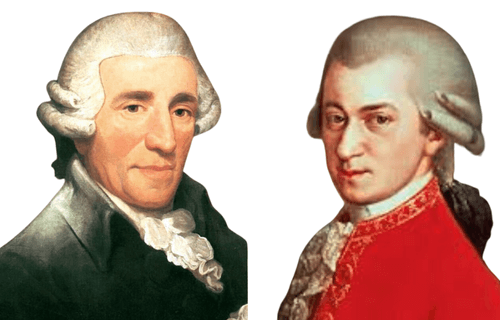
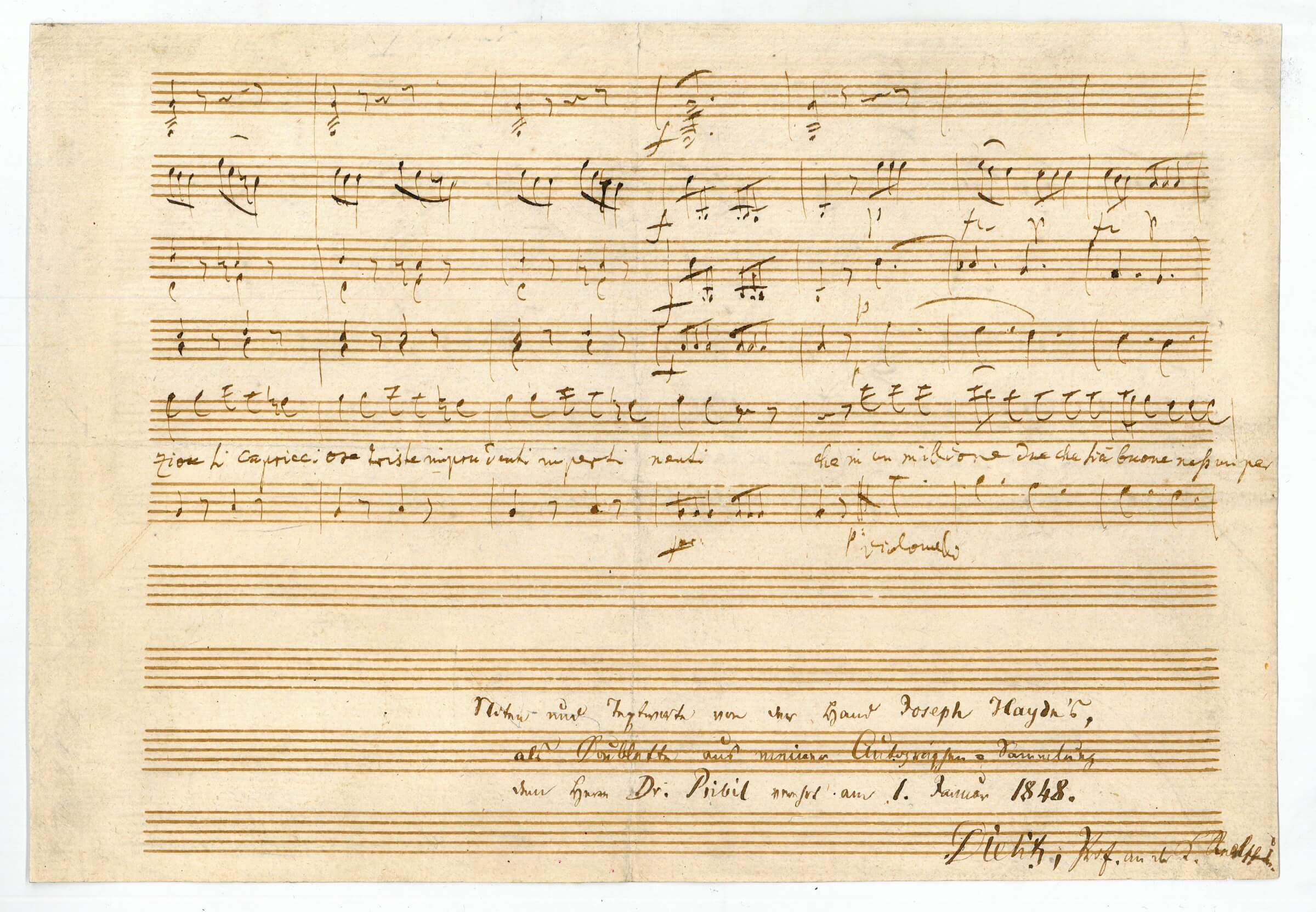
Symphony No. 101 in D Major “The Clock”
Franz Joseph Haydn (1732–1809)
Written: 1793-94
Movements: Three
Style: Classical
Duration: 28 minutes
By the time of Haydn’s first visit to London in January of 1791 he was 58 years old and for the previous three decades had been working in glorious isolation at the court of the Esterhazy family - initially at Eisenstadt, around 30 miles from Vienna, and later at their new palace at Esterhazy in Hungary. Glorious that is to say for Haydn, the court musicians hated it, and here he was ‘forced to become original’. A constant stream of musical ingenuity produced dozens of wonderful and creative symphonies, sonatas, string quartets and music of every form. Haydn was firmly established as the most successful composer of his generation.
This all changed in 1790 however when the death of his chief patron, Prince Nikolaus I, enabled him not only to travel within Austria but also take up the invitation of impresario Johann Peter Salomon to visit and perform in London. The main product of this invigorating new era was to be a series of twelve works known, inevitably if somewhat unimaginatively, as the London Symphonies.
The only words I have to describe the introduction to the first movement of Haydn’s Symphony No.101 are misterioso and even portentous. What follows however, when we get into the movement proper, the presto, is pure joy and unabashed fun! A total contrast and, I’m quite sure, entirely deliberate. Haydn was renowned for having a developed sense of musical mischief. The second movement, from which the symphony takes its name ‘The Clock’, opens with the tick-tock motif in the bassoons and plucked strings. The third movement, a minuet and trio, also has a clock connection. Around this time Haydn gave his ‘employer’ Prince Nikolaus II - a patron of the arts but with less enthusiasm for a full-time orchestra than his grandfather, Nikolaus I - a musical clock, for which he composed twelve short pieces. This is one of them! The finale is an unusual type of Rondo where the main theme (and there is only one) is varied, embellished and elaborated on each of its appearances. Finally, all this energy is worked up in a short, dramatic fugue to close the symphony.
© 2025 Andrew Constantine