25–26 Classics 3 – Program Notes: Valentine’s with Romeo and Juliet
7:30 PM | Santander Preforming Arts Center
Classics 3
Various Works
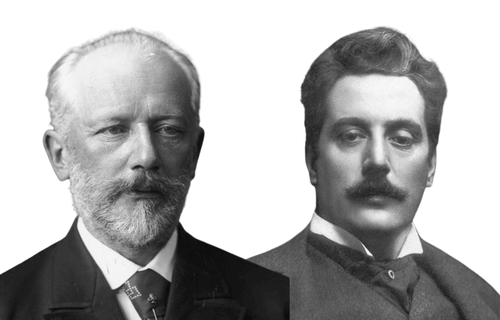
Pyotr Ilyich Tchaikovsky (1840–1893)
Giacomo Puccini (1858–1924)
Written: 1869–1924
Movements: Overtures, Arias
Style: Romantic to Late-Romantic
Duration: 70 minutes
Valentine’s with Romeo and Juliet
Born in Lucca in December 1858, Giacomo Puccini was very much seen as the heir to the great Italian opera composer, Giuseppe Verdi. Coming from a family with four generations of musicians who had filled the role of “maestri di cappella,” that is, directors of music at the cathedral in Lucca, it was fairly inevitable that Puccini should follow in the family tradition and become a musician. However, the fact that his father died when he was just five years old meant that he was obviously too young to step directly into his shoes.
After several years of a more general education, Puccini attended the conservatory of music in Milan. In his earlier years, he was often regarded as lazy but, once he began studying in Milan, Puccini’s talent began to emerge, most notably with his orchestral work Capriccio sinfonico. Over the next forty one years he captured great public acclaim and status with such operas as, La boheme, Madame Butterfly, Tosca, Turandot and many others.
The same year as Puccini received attention for his Capriccio sinfonico, he was encouraged to enter his first opera, Le Villi (The Fairies), into a competition for a new, unperformed opera "inspired by the best traditions of Italian opera", which could be "idyllic, serious, or comic”. Rather than win the competition though, or even a prize, Puccini’s work was disqualified for being illegible! But, disappointment was short-lived and encouragement came from many important musical quarters. The publisher Ricordi offered to print the parts for free and the public premiere was a huge success. La tragenda, (The Specter) is one of two intermezzi before Act 2.
Despite minor setbacks – Edgar in 1889, with a few exceptions such as tonight’s Prelude, failed miserably with Puccini even describing it as, “warmed up soup” – Ricordi stuck with their man and continued to commission from Puccini. La bohème in 1893 stormed the musical world with showstoppers such as; Che gelida manina, (“What a cold little hand”), Si, mi chiamano Mimi, (Yes, they call me Mimi), Quando m’en vo, (When I walk) and O soave fanciulla, (Oh! Lovely girl!). The start of the twentieth century saw great successes for Puccini with Tosca and Madame Butterfly, whilst the closing years of his career produced classic arias such as O mio babbino caro, (O my dear Papa) from his 1917 comic opera Gianni Schicchi, and Nessun dorma, (none shall sleep) from his 1924 masterpiece, unfinished at his death, Turandot.
The same year as Puccini composed Edgar, Tchaikovsky was busy completing the second of his three great ballets, Sleeping Beauty. Originally written for the Imperial Ballet in St. Petersburg, to choreography by Marius Petipa, Sleeping Beauty was initially a huge success within Russia. But it was not until many years after the composer’s death that it would receive international acclaim and admiration. The complete score lasts some three hours with the famed Garland Waltz taking place in Act 1.
A little over ten years before Sleeping Beauty, Tchaikovsky composed his most celebrated opera, Eugene Onegin, which follows the tale set out in Pushkin’s verse novel of the young aristocratic dandy Onegin, the ill-fated love between he and Tatyana and the tragic outcome that befalls Lensky, who is both a friend of Onegin and the fiancé of Tatyana’s sister Olga. Tatyana’s aria, the Letter Scene, Пускай погибну я, но прежде…(Let me die, but first…) takes place in Act 1, whilst the equally famous aria for Lensky, Куда, куда вы удалились, весны моей златые дни (Where have you gone, O golden days of my spring?) is sung in Act 2. Between the two comes the Waltz, performed at the ball being held to celebrate Tatyana’s name day.
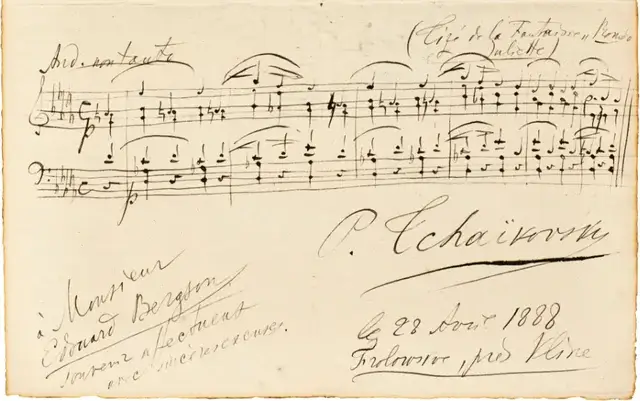
Romeo and Juliet, Shakespeare’s tale of two young ‘star-crossed lovers’, received its most dramatic musical representation in the Fantasy Overture of Tchaikovsky. In all there were actually three versions of the work with Tchaikovsky only finally, after 11 years, settling on a version he was satisfied with in 1880. The opening, so reminiscent of Russian Orthodox chanting, represents the would-be peacemaker Friar Lawrence. The instantly recognizable love-theme of Romeo is heard on viola and English horn whilst dramatic episodes of fighting appear in the scurrying strings, punctuated by jabbing daggers in the off-beat cymbals and timpani.
© 2025 Andrew Constantine
Listen