
25–26 Classics 2 – Program Notes: Mozart’s Eine kleine Nachtmusik
7:30 PM | Santander Preforming Arts Center
Andrew Constantine, Conductor
Classics 2
Wolfgang Amadeus Mozart (1756–1790) - Serenade No. 13 in G Major, K. 525 “Eine kleine Nachtmusik”
Written: 1787
Movements: Three
Style: Classical
Duration: 18 minutes
Perhaps Mozart’s mostly universally recognizable and beloved of works, Eine kleine Nachtmusik, or the Serenade No. 13 in G Major, was composed in August 1787 when the composer was 31 years old and in the middle of work on the second act of his opera, Don Giovanni. Why he should take such a detour from this major undertaking is unclear. Usually for Mozart, the composing of a serenade would be the result of a specific commission, often from a wealthy patron. There’s no evidence of such a request but it’s probably safe to assume that one did take place.
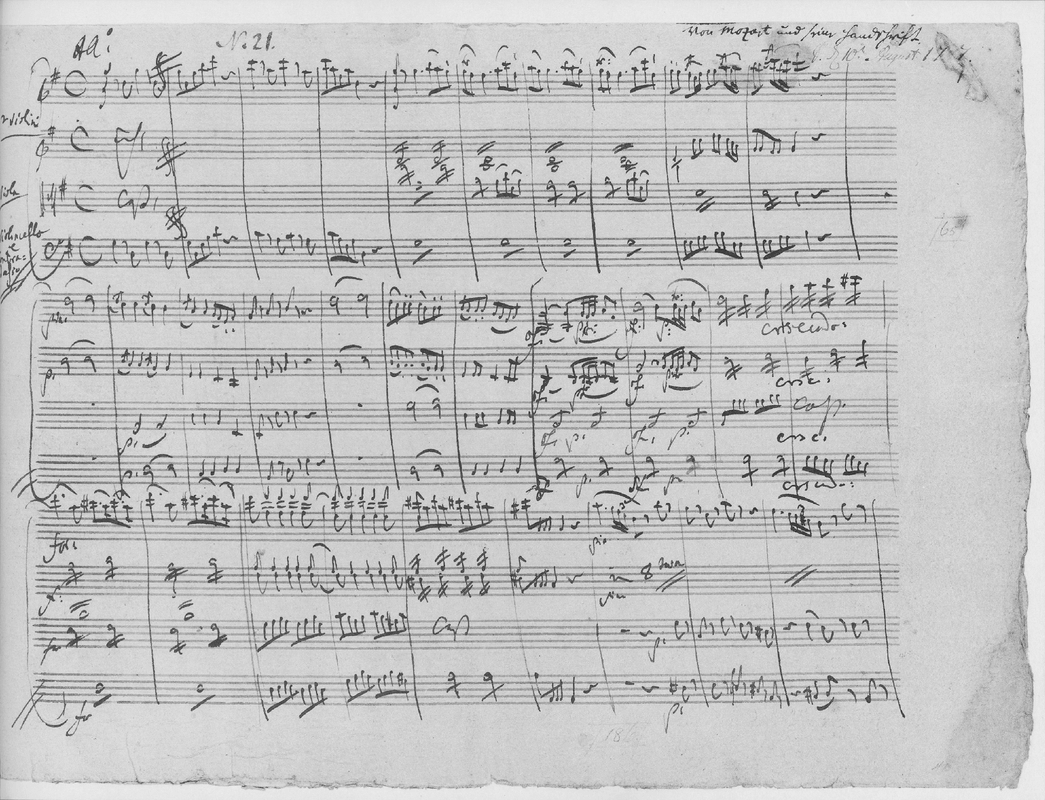
In Mozart’s own catalogue of works he entered this serenade on August the 10th as Eine kleine Nacht-Musick, although it’s highly doubtful that he intended this to be a specific title. Only when the serenade was finally published around 1827, 36 years after his death, did this become its ‘official’ name. We can surmise that when, at this time, the composer’s widow Constanze sold a bundle of his papers to the publisher Johann Andre the natural business instinct would have been to find a way of maximizing the potential for commercial gain. What is also interesting about this catalogue entry is that Mozart lists it as being a five movement serenade, as was the custom for the time. Today we only know it as a four movement work. The fate of the lost second movement, a minuet and trio, is unknown, and also the reason why it should have been removed in the first place.
Another aspect of this serenade which, for the era, is unusual is the absence of any wind instruments. Instead Mozart conceived it for two violins, viola, cello and bass, whilst today we are more likely to hear it performed by a fuller string ensemble. Each of the extant movements is instantly recognizable, particularly the outer ‘allegro’ movements. The first begins with a few bars, a unison gesture from the whole group, which then propels us into the dynamic and energized first tune. The second movement is a Romance, surely the core role of any serenade, the third a stately and measured minuet and trio, while the finale is a boisterous, playful and at times tumbling rondo.
© 2025 Andrew Constantine
Edward Elgar (1857–1934) - Cello Concerto in E Minor, Op. 85
Written: 1919
Movements: Four
Style: Late Romantic
Duration: 30 minutes
It seemed that Elgar's world was crumbling in 1918. Four years of war had left him, as so many others, weary and numb from the crush of events.
Many of his friends of German ancestry were put through a bad time in England during those years; others whom he knew were killed or maimed in action. The traditional foundations of the British political system were skewed by the rise of socialism directly after the war, and Elgar saw his beloved Edwardian world drawing to a close. The health of his wife, his chief helpmate, inspiration and critic, began to fail, and with her passing in 1920, Elgar virtually stopped composing. The Cello Concerto, written just before his wife's death, is Elgar's last major work.
Large sections of the Concerto are given over to the solitary ruminations of the cello in the form of recitative-like passages, such as the one that opens the work. The forms of the Concerto's four movements only suggest traditional models in their epigrammatic concentration. The first movement is a ternary structure (A-B-A), commencing after the opening recitative. It takes several tries before the second movement is able to maintain its forward motion, but when it does, it proves to be a skittering, moto perpetuo display piece for the soloist. The almost-motionless stillness of the Adagio returns to the introspection of the opening movement. The finale, like the opening, is prefaced by a recitative for the soloist. The movement's form following this introductory section is based on the Classical rondo, and makes a valiant attempt at the "hail-and-well-met" vigor of Elgar's earlier march music. Like the second movement, however, it seems more a nostalgic recollection of past abilities than a display of remaining powers. Toward the end, the stillness of the third movement creeps over the music, and the soloist indulges in an extended soliloquy. Bits of earlier movements are remembered before a final recall of the fast rondo music.
©2007 Dr. Richard E. Rodda

Listen
Johannes Brahms (1833–1897) - Symphony No. 2 in D Major, Op. 73
Written: 1877
Movements: Four
Style: Romantic
Duration: 45 minutes
In the summer of 1877, Brahms repaired to the village of Pörtschach in the Carinthian hills of southern Austria. He wrote to a Viennese friend, “Pörtschach is an exquisite spot, and I have found a lovely and apparently pleasant abode in the Castle! The place is replete with Austrian coziness and kindheartedness." The lovely country surroundings inspired Brahms' creativity to such a degree that he wrote to the critic Eduard Hanslick, "So many melodies fly about, one must be careful not to tread on them." Brahms plucked from the gentle Pörtschach breezes a surfeit of beautiful music for his Second Symphony, which was apparently written quickly during that summer.
The Symphony opens with a three-note motive, presented softly by the low strings, which is the germ seed from which much of the thematic material of the movement grows. The horns sing the principal theme, which includes, in its third measure, the three-note motive. The sweet second theme is given in duet by the cellos and violas. The development begins with the horn's main theme, but is mostly concerned with permutations of the three-note motive around which some stormy emotional sentences accumulate. The placid mood of the opening returns with the recapitulation, and remains largely undisturbed until the end of the movement.
The second movement plumbs the deepest emotions in the Symphony. Many of its early listeners found it difficult to understand because they failed to perceive that, in constructing the four broad paragraphs comprising the Second Symphony, Brahms deemed it necessary to balance the radiant first movement with music of thoughtfulness and introspection in the second. This movement actually covers a wide range of sentiments, shifting, as it does, between light and shade—major and minor. Its form is sonata-allegro, whose second theme is a gently syncopated strain intoned by the woodwinds above the cellos' pizzicato notes.
The Allegretto is a delightful musical sleight-of-hand. The oboe presents a naive, folklike tune in moderate triple meter as the movement's principal theme. The strings take over the melody in the first Trio, but play it in an energetic duple-meter transformation. The return of the sedate original theme is interrupted by another quick-tempo variation, this one a further development of motives from Trio I. A final traversal of the main theme closes this delectable movement.
The finale bubbles with rhythmic energy and high spirits. The main theme starts with a unison gesture in the strings, but soon becomes harmonically active and spreads through the orchestra; the second theme is a broad, hymnal melody. The development begins with a statement of the main theme in the tonic before branching into discussion of the movement's motives. The recapitulation recalls the earlier themes, and leads through the triumphant coda to the brazen glow of the final trombone chord.
©2014 Dr. Richard E. Rodda