
25-26 Classics 1 – Program Notes: Beethoven 9
7:30 PM | Santander Preforming Arts Center
Classics 1
Symphony No. 9 in D Minor, Op. 125 “Choral Symphony”
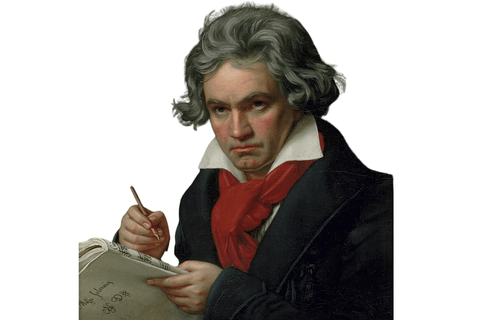
Ludwig van Beethoven (1770–1827)
Written: 1822-182
Movements: Four
Style: Classical-Romantic (transitional)
Text: Friedrich Schiller's "Ode to Joy"
Duration: 70 minutes
Unlike anything that had preceded it, Beethoven’s Symphony No.9 in D minor was first performed on May 7th, 1824 in Vienna. Originally, it appears, Berlin was to have been the location for the premier, the composer fearing that his time as the musical hero of the Austrian capital was over. However, when Beethoven’s circle of important admirers and supporters in Vienna heard of the plan they implored him to reconsider. It was to be Beethoven’s first appearance on stage for twelve years!
At this point Beethoven was almost completely deaf and, although specific details are at times contradictory, it is clear that whilst he stood on the podium to lead the performance, the actual musical direction of the orchestra would best be described as a ‘team effort’. The official conductor was Michael Umlauf, with the composer at his side: “Beethoven himself conducted, that is, he stood in front of a conductor’s stand and threw himself back and forth like a madman”. The scherzo movement was interrupted by applause, Beethoven continued to conduct even after the music had finished - apparently lost - and the soprano soloist had to turn him around at one point to acknowledge the adoration from the audience! Nevertheless, this under rehearsed event, attended by the likes of Schubert, Carl Czerny and Chancellor Meternicht was a huge success.
From the very beginning it is obvious that we are being escorted on a journey whose significance goes way beyond musical entertainment. The mysterious, mist-enveloped whisperings of the strings at the opening move from insignificance to portentous terror and lead us into the first appearance of the main ‘melodic’ theme. Throughout the length of the first movement this ‘melody’ –– perhaps more of an angry defiant gesture - dominates the entire landscape. It’s ruminations, unexpected key changes and lengthy episodes of repetition seem designed almost to keep the listener in a controlled stupor rather than allow their ear to be enchanted by ‘delightful melody’. There is a force of nature at work, manipulative and, perhaps, malign.
The second movement, the scherzo, continues the drama established in the first movement. However, the momentum is now significantly increased and the character of the music, though still angular and even spikey, in melodic shape, takes on a manic almost disturbed persona. Even when we enter the central trio section this is no ‘fun loving’ movement, as we might haveexpected given previous examples in Beethoven’s symphonies.
By complete contrast when we arrive, after almost thirty minutes of music, at the third movement – a slow movement marked Adagio molto e cantabile (very slowly and singing) – Beethoven suddenly creates a mood of intense reflection and contemplation. Considering the context of the whole Ninth Symphony we might take a moment to regard where the composer’s life stood at this point. He was in his early fifties, living in self-inflicted squalor and constant physical pain, having little contact with the outside world and hugely bitter that fate had left him almost completely deaf. Perhaps the opening two movements describe his raging at the world and then the mental turmoil it had created within him? This calm adagio however, is essentially a set of variations with two gentle themes. The first of these sets up the mood of introspection and thoughtfulness while the second, curiously marked by Beethoven just ever so slightly faster, begins the move to a more upbeat and almost liberated state of mind.
Now we have arrived at the iconic, history changing, finale. After an opening scream of a fanfare, Beethoven tries to restore order with the cellos and basses giving us an early taste of things to come. The composer looks for a way ahead – mentally as well as musically –– and we hear tiny echoes of the previous three movements. But none of these are to be the chosen path and each is angrily rejected by the lower strings before, gradually, we hear the emergence of the theme that eventually becomes the ‘Ode to Joy’. A repeat of the opening fanfare heralds the appearance of the baritone soloist. And, at this point, symphonic music entered a new dimension.
For over thirty years Beethoven had held the desire of setting Schiller’s ‘An die Freude’, or Ode to Joy, to music. The intervening Napoleonic era had brought dissolution on the one hand but strengthened resolve in Beethoven’s love of “liberty above all things” on the other. The seemingly autobiographical aspects of the first three movements, so fully rejected at the beginning of the last movement, and the powerful affirmation of optimism throughout the closing sections speak volumes to the strength of Beethoven’s will, determination and capacity for positive thinking. The combination of vocal forces and orchestra in a symphonic setting was unheard of at this point and Beethoven must have known full well that he was, yet again, the chosen one, taking the art form into new realms of expression. “Alle Menschen werden Brüder”, All men shall be brothers!
© 2025 Andrew Constantine

Listen
Text and Translation
| O Freunde, nicht diese Töne! Sondern laßt uns angenehmere anstimmen, und freudenvollere. |
Oh friends, not these sounds! Let us instead strike up more pleasing and more joyful ones! |
| Freude! Freude! |
Joy! Joy! |
| Freude, schöner Götterfunken Tochter aus Elysium, Wir betreten feuertrunken, Himmlische, dein Heiligtum! Deine Zauber binden wieder Was die Mode streng geteilt; Alle Menschen werden Brüder, Wo dein sanfter Flügel weilt. |
Joy, beautiful spark of divinity, Daughter from Elysium, We enter, burning with fervour, heavenly being, your sanctuary! Your magic brings together what custom has sternly divided. All men shall become brothers, wherever your gentle wings hover. |
| Wem der große Wurf gelungen, Eines Freundes Freund zu sein; Wer ein holdes Weib errungen, Mische seinen Jubel ein! Ja, wer auch nur eine Seele Sein nennt auf dem Erdenrund! Und wer's nie gekonnt, der stehle Weinend sich aus diesem Bund! |
Whoever has been lucky enough to become a friend to a friend, Whoever has found a beloved wife, let him join our songs of praise! Yes, and anyone who can call one soul his own on this earth! Any who cannot, let them slink away from this gathering in tears! |
| Freude trinken alle Wesen An den Brüsten der Natur; Alle Guten, alle Bösen Folgen ihrer Rosenspur. Küsse gab sie uns und Reben, Einen Freund, geprüft im Tod; Wollust ward dem Wurm gegeben, Und der Cherub steht vor Gott. |
Every creature drinks in joy at nature's breast; Good and Evil alike follow her trail of roses. She gives us kisses and wine, a true friend, even in death; Even the worm was given desire, and the cherub stands before God. |
| Froh, wie seine Sonnen fliegen Durch des Himmels prächt'gen Plan, Laufet, Brüder, eure Bahn, Freudig, wie ein Held zum Siegen. |
Gladly, just as His suns hurtle through the glorious universe, So you, brothers, should run your course, joyfully, like a conquering hero. |
| Seid umschlungen, Millionen! Diesen Kuß der ganzen Welt! Brüder, über'm Sternenzelt Muß ein lieber Vater wohnen. Ihr stürzt nieder, Millionen? Ahnest du den Schöpfer, Welt? Such' ihn über'm Sternenzelt! Über Sternen muß er wohnen. |
Be embraced, you millions! This kiss is for the whole world! Brothers, above the canopy of stars must dwell a loving father. Do you bow down before Him, you millions? Do you sense your Creator, O world? Seek Him above the canopy of stars! He must dwell beyond the stars. |