
26-27 Classics 1 – Program Notes: Symphony No. 2 in E minor, Op. 27
7:30 PM | Santander Preforming Arts Center
Symphony No. 2 in E minor, Op. 27
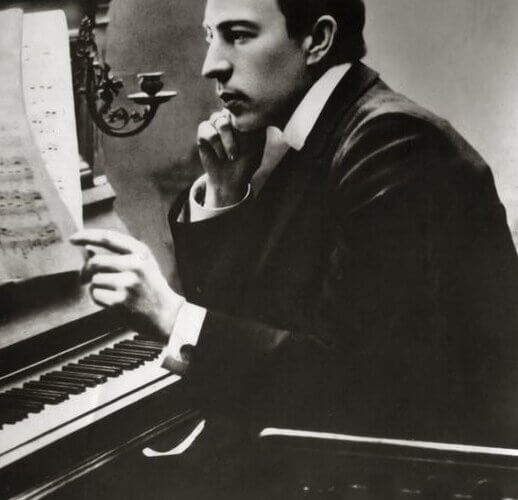
Sergei Rachmaninoff (1873-1943)
Composed in 1906-1907.
Premiered on January 26, 1908 in St. Petersburg, conducted by the composer.
Early in 1906, Rachmaninoff decided to sweep away the rapidly accumulating obligations of conducting, concertizing and socializing that cluttered his life in Moscow in order to find some quiet place in which to devote himself to composition. His determination may have been strengthened by the political unrest beginning to rumble under the foundations of the aristocratic Russian political system. The uprising of 1905 was among the first signs of trouble for those of his noble class (his eventual move to the United States was a direct result of the swallowing of his family’s estate and resources by the 1917 Revolution), and he probably thought it a good time to start looking for a quiet haven.
A few years before, Rachmaninoff had been overwhelmed by an inspired performance of Die
Meistersinger he heard at the Dresden Opera. The memory of that evening and the aura of dignity and repose exuded by the city had remained with him, and Dresden, at that time in his life, seemed like a good place to be. The atmosphere in Dresden was so conducive to composition that within a few months of his arrival he was working on the Second Symphony, the First Piano Sonata, the Op. 6 Russian folk songs and the symphonic poem The Isle of the Dead. The Second Symphony was unanimously cheered when it was premiered under the composer’s direction in St. Petersburg on January 26, 1908.
The majestic scale of the Symphony is established at the outset by a slow, brooding introduction. The low strings and then the violins give out a fragmentary theme which generates much of the material for the entire work. A smooth transition to a faster tempo signals the arrival of the main theme, an extended and quickened transformation of the basses’ opening motive. The expressive second theme enters in the woodwinds. The development deals with the vigorous main theme to such an extent that the beginning of the formal recapitulation is engulfed by its surging sweep. The lovely second theme reappears as expected, again in the woodwinds. The coda resumes the energetic mood of the development to build to the fine climax that ends the movement.
The second movement is the most nimble essay to be found in Rachmaninoff’s orchestral works. After two preparatory measures, the horns hurl forth the main theme, which bears more than a passing resemblance to the Dies Irae, the ancient chant from the Roman Catholic Mass for the Dead that haunted the composer for many years. The vital nature of the music, however, does not support any morbid interpretation. Eventually, the rhythmic bustle is suppressed and finally silenced to make way for the movement’s central section, whose skipping lines embody some of Rachmaninoff’s best fugal writing. Almost as if by magic, the opening scherzo returns amid a full-throated cry from the brass. Once again, this quiets and the movement ends on a note of considerable mystery.
The rapturous third movement, wrote Patrick Piggott, “is as romantic as any music in the orchestral repertory — if by romantic we mean the expression, through lyrical melody and richly chromatic harmony, of a sentiment which can only be described as love.” This is music of heightened passion that resembles nothing so much as an ecstatic operatic love scene. Alternating with the joyous principal melody is an important theme from the first movement, heard prominently in the central portion and the coda of this movement.
The finale bursts forth in the whirling dance rhythm of an Italian tarantella. The propulsive urgency subsides to allow another of Rachmaninoff’s wonderful, sweeping melodic inspirations to enter. A development of the tarantella motives follows, into which are embroidered thematic reminiscences from each of the three preceding movements. The several elements of the finale are gathered together in the closing pages to produce the rich and sonorous tapestry appropriate for the life-affirming conclusion of this grand and stirring Symphony.
© Dr. Richard E. Rodda

Listen
Violin Concerto in E minor, Op. 64
Felix Mendelssohn (1809-1847)
Composed in 1844.
Premiered on March 13, 1845 in Leipzig, conducted by Niels Gade with Ferdinand David as Soloist.
“I would like to compose a violin concerto for next winter,” Mendelssohn wrote in July 1838 to
his friend, the violinist Ferdinand David. “One in E minor keeps running through my head, and the opening gives me no peace.” It was for David that Mendelssohn planned and wrote his only mature Violin Concerto. Their friendship began when the two first met at about the age of fifteen
while the young violinist was on a concert tour through Germany. They were delighted to discover the coincidence that David had been born only eleven months after Mendelssohn in the same neighborhood in Hamburg. Already well formed even in those early years, David’s playing was said to have combined the serious, classical restraint of Ludwig Spohr, his teacher, the elegance of the French tradition and the technical brilliance of Paganini. Mendelssohn, who admired both the man and his playing, saw to it that David was appointed concertmaster of the Leipzig Gewandhaus Orchestra when he became that organization’s music director in 1835. They remained close friends and musical allies. When Mendelssohn’s health was feeble, David looked after much of the routine activity of the Gewandhaus, where he spent 37 years, and he even stepped in to conduct the premiere of Mendelssohn’s oratorio St. Paul when the composer was stricken during a measles epidemic in 1836.
The Concerto opens with a soaring violin melody whose lyricism exhibits a grand passion tinged with restless, Romantic melancholy. Some glistening passagework for the violinist leads through a transition melody to the second theme, a quiet, sunny strain shared by woodwinds and soloist. More glistening arabesques from the violinist and a quickened rhythm close the exposition. The succinct development section is largely based on the opening theme. The cadenza is used as a bridge to the recapitulation and leads seamlessly into the restatement of the movement’s thematic material. The thread of a single note sustained by the bassoon carries the Concerto to the Andante, a song rich in warm sentiment and endearing elegance. This slow movement’s center section is distinguished by its rustling accompaniment and bittersweet minor-mode melody. A dozen measures of chordal writing for strings link this movement with the finale, an effervescent sonata form.
© Dr. Richard E. Rodda